Dynamic Path
Dynamic paths enable your workflows to make intelligent routing decisions at runtime. It adapt your workflow based on the actual outputs being processed.
Components
The dynamic path system is built on these key components:
- DynamicConnector: The core class that defines routing logic and possible destinations.
- Decision Functions: Functions that analyze output and determine the next step.
- Utility Helpers: Pre-built routing functions for common scenarios.
Parameters
When creating a DynamicConnector, you need to provide these parameters:
- decision_fn: Function that takes
(output, output_type)and returns a destination key. - destinations: Dictionary mapping destination keys to task names (maximum 4 destinations).
- name (optional): Name of the connector for visualization and logging.
- mode (optional): ConnectorMode enum value for visualization purposes.
Built-in Routing Utilities
The framework provides several pre-built routing utilities in intelli.flow.utils.dynamic_utils:
- text_length_router: Routes based on text length thresholds.
- text_content_router: Routes based on keyword matches in content.
- sentiment_router: Routes based on positive/negative/neutral sentiment.
- error_router: Routes differently when errors are detected.
- type_router: Routes based on output data type.
- data_exists_router: Routes based on whether data exists or is empty.
- custom_router: Creates routes based on any custom condition function.
Example: Length-Based Routing
This example routes content to different processors based on its length:

from intelli.flow import Agent, Task, Flow, TextTaskInput
from intelli.flow.types import AgentTypes
from intelli.flow.dynamic_connector import DynamicConnector, ConnectorMode
from intelli.flow.utils.dynamic_utils import text_length_router

# Define all tasks
query_task = Task(
    TextTaskInput("Write about dynamic routing in AI systems."),
    Agent(
        agent_type=AgentTypes.TEXT.value,
        provider="anthropic",
        mission="Generate text of varying length",
        model_params={"key": ANTHROPIC_API_KEY, "model": "claude-sonnet-5"},
    ),
    log=True,
)

short_task = Task(
    TextTaskInput("Summarize this short text in one sentence:"),
    Agent(
        agent_type=AgentTypes.TEXT.value,
        provider="openai",
        mission="Process short text",
        model_params={"key": OPENAI_API_KEY, "model": "gpt-5.5"},
    ),
    log=True,
)

medium_task = Task(
    TextTaskInput("Extract the main points from this text:"),
    Agent(
        agent_type=AgentTypes.TEXT.value,
        provider="openai",
        mission="Process medium text",
        model_params={"key": OPENAI_API_KEY, "model": "gpt-5.5"},
    ),
    log=True,
)

long_task = Task(
    TextTaskInput("Create a detailed analysis of this comprehensive text:"),
    Agent(
        agent_type=AgentTypes.TEXT.value,
        provider="openai",
        mission="Process long text",
        model_params={"key": OPENAI_API_KEY, "model": "gpt-5.5"},
    ),
    log=True,
)

# Collect all tasks
tasks = {
    "query": query_task,
    "short_processor": short_task,
    "medium_processor": medium_task,
    "long_processor": long_task,
}

# Define length router function
def length_router(output, output_type):
    return text_length_router(
        output, output_type, [100, 200], ["short", "medium", "long"]
    )

# Define all connections
map_paths = {}  # No static connections in this example

dynamic_connectors = {
    "query": DynamicConnector(
        decision_fn=length_router,
        destinations={
            "short": "short_processor",    # If text length <= 100
            "medium": "medium_processor",  # If 100 < text length <= 200
            "long": "long_processor",      # If text length > 200
        },
        name="length_router",
        description="Routes based on text length",
        mode=ConnectorMode.LENGTH_BASED,
    )
}

# Create and run the flow
flow = Flow(
    tasks=tasks,
    map_paths=map_paths,
    dynamic_connectors=dynamic_connectors,
    log=True,
)

# Generate flow visualization
flow.generate_graph_img(name="length_based_routing", save_path="./temp")

# Execute the flow (in an async context)
results = await flow.start(max_workers=3)
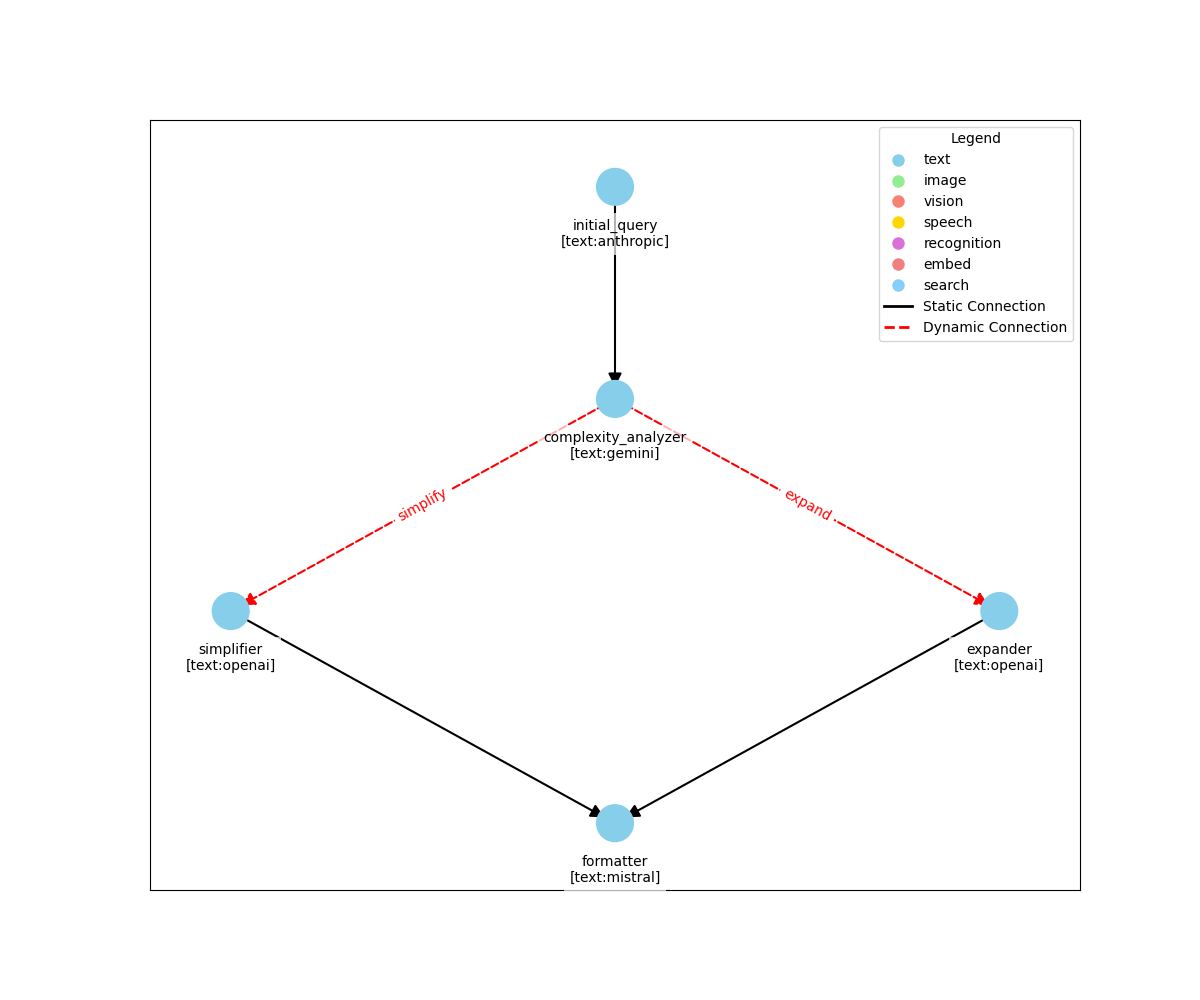
Example: Complex Workflow
This example demonstrates a more complex workflow with both static and dynamic connections:
from intelli.flow import Agent, Task, Flow, TextTaskInput
from intelli.flow.types import AgentTypes
from intelli.flow.dynamic_connector import DynamicConnector, ConnectorMode

# Define all tasks
initial_task = Task(
    TextTaskInput("Create a detailed explanation of a complex technical topic."),
    Agent(
        agent_type=AgentTypes.TEXT.value,
        provider="openai",
        mission="Generate initial content",
        model_params={"key": OPENAI_API_KEY, "model": "gpt-5.5"},
    ),
    log=True,
)

analyzer_task = Task(
    TextTaskInput("Analyze if this content is too complex for a beginner:"),
    Agent(
        agent_type=AgentTypes.TEXT.value,
        provider="openai",
        mission="Analyze content complexity",
        model_params={"key": OPENAI_API_KEY, "model": "gpt-5.5"},
    ),
    log=True,
)

simplifier_task = Task(
    TextTaskInput("Simplify this complex content for beginners:"),
    Agent(
        agent_type=AgentTypes.TEXT.value,
        provider="openai",
        mission="Simplify complex content",
        model_params={"key": OPENAI_API_KEY, "model": "gpt-5.5"},
    ),
    log=True,
)

expander_task = Task(
    TextTaskInput("Expand on this topic with more details and examples:"),
    Agent(
        agent_type=AgentTypes.TEXT.value,
        provider="openai",
        mission="Expand on the topic",
        model_params={"key": OPENAI_API_KEY, "model": "gpt-5.5"},
    ),
    log=True,
)

simple_formatter_task = Task(
    TextTaskInput("Format this simplified content nicely with markdown:"),
    Agent(
        agent_type=AgentTypes.TEXT.value,
        provider="mistral",
        mission="Format content",
        model_params={"key": MISTRAL_API_KEY, "model": "mistral-medium-latest"},
    ),
    log=True,
)

detailed_formatter_task = Task(
    TextTaskInput("Format this detailed content nicely with markdown:"),
    Agent(
        agent_type=AgentTypes.TEXT.value,
        provider="mistral",
        mission="Format content",
        model_params={"key": MISTRAL_API_KEY, "model": "mistral-medium-latest"},
    ),
    log=True,
)

# Collect all tasks
tasks = {
    "initial_query": initial_task,
    "complexity_analyzer": analyzer_task,
    "simplifier": simplifier_task,
    "expander": expander_task,
    "simple_formatter": simple_formatter_task,
    "detailed_formatter": detailed_formatter_task,
}

# Define complexity router function
def complexity_router(output, output_type):
    if output_type != "text":
        return "expand"  # Default

    # Check if the analysis suggests simplification
    output_lower = output.lower()
    if any(term in output_lower for term in [
        "complex", "difficult", "advanced", "simplify", "too technical"
    ]):
        return "simplify"
    else:
        return "expand"

# Define all connections
map_paths = {
    # Static connections
    "initial_query": ["complexity_analyzer"],
    # Each branch has its own formatter. A formatter shared by both
    # branches would wait for the branch that did not run.
    "simplifier": ["simple_formatter"],
    "expander": ["detailed_formatter"],
}

dynamic_connectors = {
    # Dynamic connections
    "complexity_analyzer": DynamicConnector(
        decision_fn=complexity_router,
        destinations={
            "simplify": "simplifier",
            "expand": "expander",
        },
        name="complexity_router",
        description="Routes based on content complexity",
        mode=ConnectorMode.CONTENT_BASED,
    )
}

# Create and run the flow
flow = Flow(
    tasks=tasks,
    map_paths=map_paths,
    dynamic_connectors=dynamic_connectors,
    log=True,
)

# Generate flow visualization
flow.generate_graph_img(name="complex_workflow", save_path="./temp")

# Execute the flow (in an async context)
results = await flow.start(max_workers=3)
Get the next agent guide in your inbox.
Be the first to read new guides on AI agents, RAG and MCP apps.