Why IntelliNode
Most agent frameworks ask you to accept something: a long list of dependencies that can clash with the packages already in your project, or a graph you can only see in a separate tool. IntelliNode is an open source framework for building AI agents, RAG and MCP apps in Python and Node.js, and it is built to avoid both.
This page is about what you get with IntelliNode, and what to expect if you come to it from another framework.
What makes IntelliNode different
Light, so it fits into the project you already have. The Python core declares three dependencies, and so does the Node.js package. The browser build has none. Few dependencies means few version pins, so IntelliNode drops into an existing codebase without fighting the libraries that are already there. Heavier features, such as offline models, computer use or the flow pictures, are optional extras you install only when you need them.
You can see the agent, with no extra tool. Every Intelli flow draws itself as a picture from the same code: each step, the model and provider behind it, and the routes between steps. Drawing calls no model and needs no key or server, so a teammate who doesn't read code can review the plan before it runs. See Flows.
Shared memory between agents. Steps in a flow write their results to a shared memory, and later steps read from it, so several agents reason over the same facts instead of passing one string down a chain. A 2025 IEEE paper co-written by IntelliNode's author built its agents on IntelliNode this way: analysis agents for lab results, vital signs and clinical context ran first and shared their memory with the prediction and validation agents. The multi-agent version predicted ICU mortality more accurately than a single agent (59% against 56%) and cut the length of stay error from 5.82 to 4.37 days. Read the paper: Enhancing Clinical Decision-Making: Integrating Multi-Agent Systems with Ethical AI Governance.
One API for every model, and a different one per step. OpenAI, Anthropic, Gemini and Vertex AI, Mistral, Cohere, NVIDIA and Amazon Bedrock, plus local models through Ollama, vLLM and llama.cpp, all in the core package. Each step of a flow can use a different one, so a free local model can sort tickets while a stronger model writes the reply.
A Claude Code plugin you can watch. The intelli-flows plugin teaches Claude Code and Codex to build with Intelli. You ask for a tool in plain words. The agent plans it as a flow, saves the picture before anything runs, then runs it and explains the result. You see every step and the model behind it before the first call, so the coding agent stays visible and transparent.
Vibe agents. Describe what you want in a sentence, and a VibeAgent plans it into a flow: the right agent types for text, image, speech or tools, the steps, and the routes between them. The result is a normal flow, so you can draw it, edit it and run it like one you wrote by hand.
Models from the browser, with no backend. The Node.js library also ships as a single script for the browser, with zero dependencies. Load it from a CDN and call OpenAI, Anthropic, Gemini, Mistral, Cohere or Stability AI straight from the page, with chat, streaming, JSON output and tool calling. It suits prototypes, internal tools and apps where each user brings their own key. See Frontend JavaScript.
Side by side
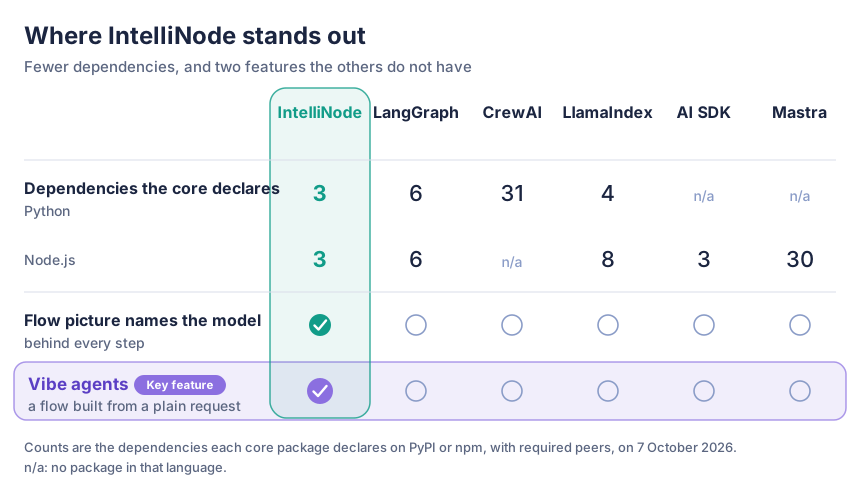
Dependency counts are what each core package declares on PyPI or npm, including required peer packages, checked on 7 October 2026.
What you can build with it
- Multi-step agents as flows: steps that run in sequence or side by side, routes decided at runtime, loops with a stop rule, and tool calls through MCP. See Flows and dynamic paths.
- Assistants with RAG and memory: answers from your documents with numbered sources, saved conversations and long-term memory, with one interface for Pinecone, Qdrant, pgvector, MongoDB Atlas, Firestore and more. See the Assistant.
- MCP servers and clients that give any model, and any coding agent, the same tools. See the MCP server.
- A coding agent that works inside a folder you choose, edits files and runs your tests until they pass. See the coding agent.
- A computer use agent that operates a screen or a browser when there is no API to call, with hooks for a person to approve actions. See computer use.
- Browser apps that talk to models directly, with no server in between. See Frontend JavaScript.
Coming from another framework
- From LangGraph. Your state graph becomes a flow of tasks: routes are plain functions, shared memory takes the place of the state object, and the picture takes the place of a separate studio. For a side by side example, see agentic workflows in Python without LangGraph.
- From CrewAI. Each role becomes a step on the model you choose, so a run is easier to predict and to draw. Steps still share memory, so agents can build on each other's work.
- From LlamaIndex. The Assistant covers the common RAG path, and its vector stores talk to each database over its API, so most need no extra package.
- From the Vercel AI SDK. The one-API idea is the same. IntelliNode adds agents, the Assistant and an MCP server on the server side, and the two work well together with any UI on top.
- From Mastra. The core is far smaller and you can keep the same design in Python.
Try it
pip install intelli      # Python
npm i intellinode        # Node.js
Start with Flows in Python, or the Node.js introduction. To let Claude Code or Codex build the first flow for you, see Give IntelliNode to Claude Code or Codex.
Questions
Is IntelliNode free?
Yes. Both libraries are open source under the Apache 2.0 license. You pay only the model providers you choose, or nothing with local models.
Will IntelliNode conflict with packages already in my project?
It is unlikely. The Python core pins only three small libraries, and the Node.js package three as well, so there is little to clash with. Optional features bring their own extras, and you install those only when you use them.
Can I use IntelliNode with models that run on my own machine?
Yes. Point a step at Ollama, vLLM or llama.cpp, and the same code runs without any API key. See the offline models pages.
Can I move from LangGraph or CrewAI step by step?
Yes. Move one agent at a time: write it as an Intelli flow, compare the output with the old version, then switch. IntelliNode doesn't need to own your whole app.